
Eröffnung 6.September 2026 um 16:00
7. September bis 2. Oktober 2026
es spricht Nina Schedlmayer
Nicole Pruckermayr / Sabina Hörtner
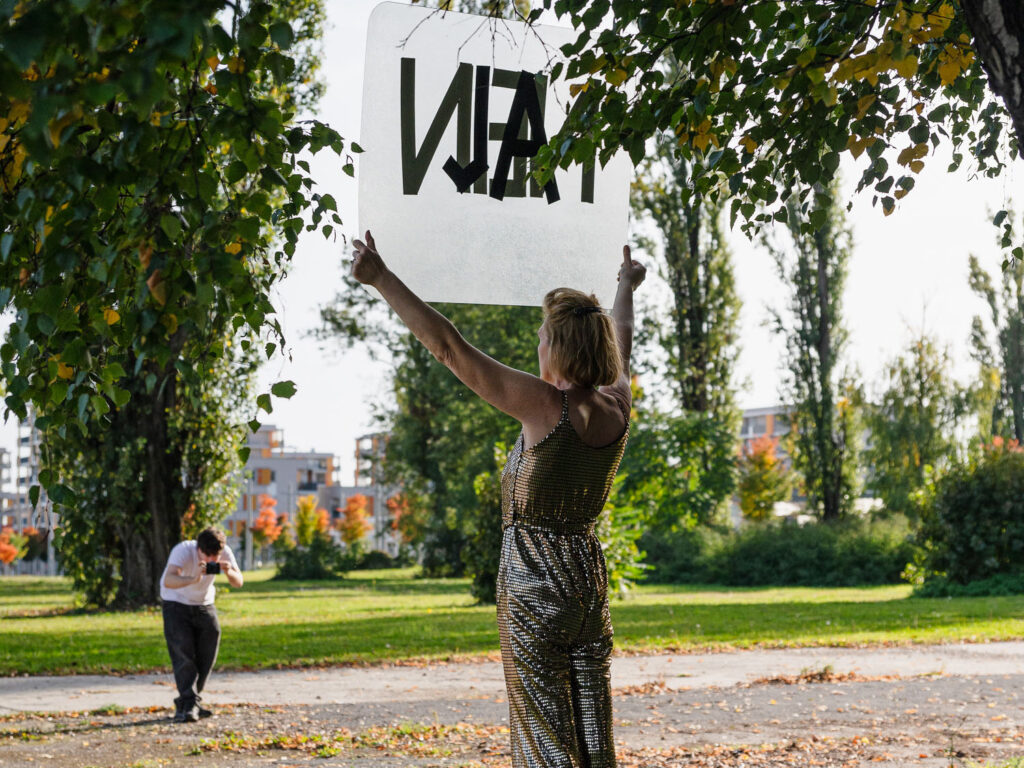
Performance am 11. Oktober 2025, Graz/Reininghaus
Foto © Nr 10_ © Nikos Zachariadis
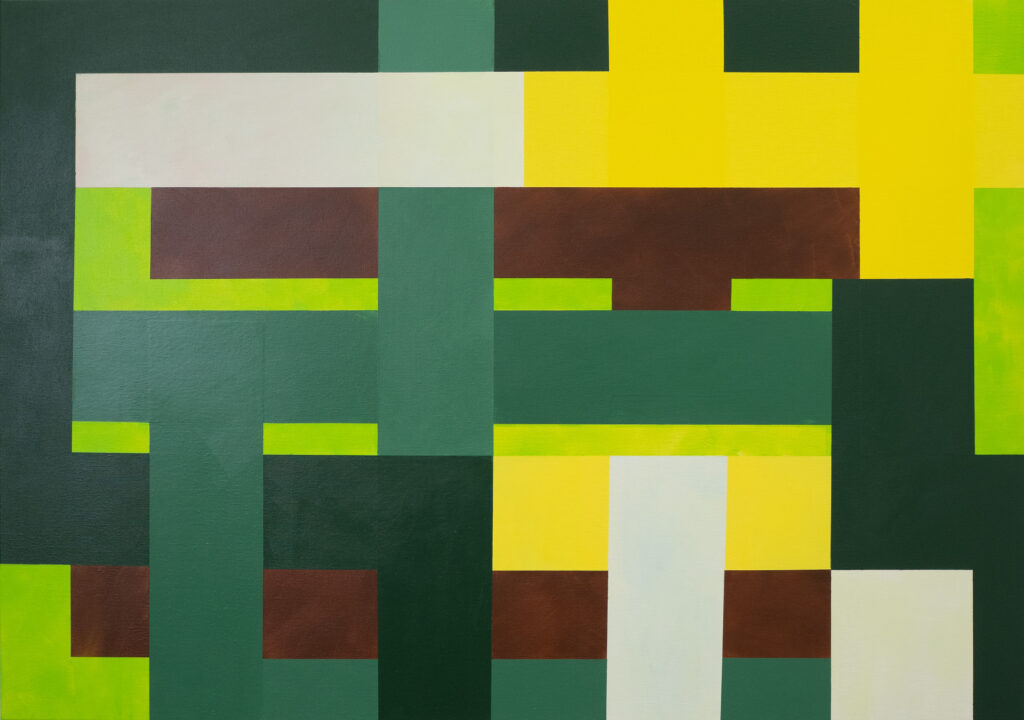
95 x 135 cm, Acryl auf Leinwand Foto © Robert Najar
Die Ausstellung ours, not mine zeigt mit Nicole Pruckermayr und Sabina Hörtner zwei Künstlerinnen, die unabhängig voneinander eine vergleichbare Methode entwickelt haben: Sie verknüpfen unter Schutz stehenden oder bereits verschwundenen Pflanzen mit konkreten Personen durch Patenschaften. Diese Setzung ist kein dekoratives Mittel, sondern ein konzeptueller Eingriff. Eine Pflanze wird einer Person zugeordnet – und damit aus der anonymen Umgebung herausgelöst.
Durch diese Verbindung entsteht Verantwortung. Pflanzen werden nicht mehr als austauschbare Elemente des Umraums wahrgenommen, sondern als Träger von Beziehungen, als Subjekt. Umgekehrt wird die Person in ein ökologisches Gefüge eingeschrieben.
Bei Sabina Hörtner stehen vom Aussterben bedrohte Pflanzen im Fokus – unscheinbare, oft übersehene Arten, die aus unserem unmittelbaren Umfeld verschwinden. Die Patenschaft macht auf diese fragilen, kaum wahrgenommenen Details aufmerksam und überführt ökologische Gefährdung in eine persönliche Beziehung. Die daraus entstehenden skulpturalen Arbeiten als Platzhalter im öffentlichen Raum und die selektive Erinnerung als lineare Malerei stehen den Fotoarbeiten von Aktionen und Performances von Nicole Pruckermayr gegenüber.
Nicole Pruckermayr arbeitet mit Bäumen im Stadtraum. Auch hier erzeugt die Zuordnung zu einzelnen Personen eine neue Wahrnehmungsebene: Der Baum wird nicht länger als funktionales Element urbaner Planung verstanden, sondern als individuelles Gegenüber im öffentlichen Raum.
Beide Positionen arbeiten nicht illustrativ, sondern setzen auf strukturelle Veränderungen der Wahrnehmung und des Zugangs. Die Patenschaft fungiert als künstlerisches Instrument, das emotionale Bindung erzeugt und damit Aufmerksamkeit für Details im unmittelbaren Umraum schafft.
ours, not mine versteht Umwelt nicht als Kulisse, sondern als gemeinsamen Handlungsraum. Die Arbeiten der beiden Künstlerinnen formulieren eine klare Haltung: Wahrnehmung ist politisch und Beziehung schafft Bewusstsein.
Nicole Pruckermayr, geboren in Oberösterreich, lebt in Graz und Niederöblarn. Sie ist Konzeptkünstlerin und beschäftigt sich in ihrer künstlerischen Praxis mit Handlungsmöglichkeiten und Möglichkeitsräumen in öffentlichen Räumen sowie in Stadt- und Stadtentwicklungsgebieten.
Sie studierte Architektur, Visuelle Kultur und Kunstanthropologie in Graz und Wien. Ihre Arbeiten umfassen diverse KIÖR-Projekte, teils partizipativ mit vielen Beteiligten, sowie Ausstellungstätigkeiten und Performances im In- und Ausland.
Für ihr künstlerisches Schaffen erhielt sie 2019 den Kunstförderungspreis der Stadt Graz
Sabina Hörtner studierte Bildhauerei an der Akademie der bildenden Künste Wien bei Bruno Gironcoli und schloss ihr Studium 1995 mit Diplom ab. Für ihre Abschlussarbeit wurde sie mit dem Würdigungspreis der Akademie ausgezeichnet. Seit 1987 (im Frauenmuseum Bonn) ist sie mit Ausstellungen und Arbeitsaufenthalten im In- und Ausland vertreten, unter anderem in Wien, Graz, Mürzzuschlag, New York, Hongkong, Los Angeles und Amsterdam. Sie realisierte mehrere Kunst-am-Bau-Projekte, darunter WOMENT! 20+03 Orte und Augenklinikum am LKH Graz. Von 2001 bis 2004 war sie Assistant Professor am Institut für Zeitgenössische Kunst an der Technische Universität Graz.
Sabina Hörtner arbeitet interdisziplinär mit Zeichnung, Malerei, Skulptur und raumbezogenen Installationen. Der dreidimensionale Raum bildet dabei häufig den Ausgangspunkt ihrer künstlerischen Interventionen. Seit 2014 beschäftigt sie sich in ihrer Arbeit mit dem Verschwinden kleiner Details im unmittelbaren Umfeld und thematisiert dabei auch den Verlust geschützter Arten.
Sie lebt und arbeitet in Wien und im südlichen Niederösterreich. Seit 2026 betreibt sie in Wien den Kunstraum PLANET H.
English
September 7 to October 11, 2026
Opening: September 6, 2026 at 4:00 PM
The exhibition ‚ours, not mine‚ presents Nicole Pruckermayr and Sabina Hörtner, two artists who have independently developed a comparable method: they link protected or already extinct plants to specific individuals through sponsorships. This arrangement is not a decorative, but a conceptual intervention. A plant is assigned to a person—and thus removed from its anonymous surroundings.
This connection creates responsibility. Plants are no longer perceived as interchangeable elements ofthe environment, but as carriers of relationships, as subjects. Conversely, the person is inscribed within an ecological framework.
Sabina Hörtner’s work focuses on endangered plants—inconspicuous, often overlooked species that are disappearing from our immediate environment. The sponsorship draws attention to these fragile, barely noticed details and transforms ecological threat into a personal relationship. The resulting sculptural works, serving as placeholders in public space, and the selective memory depicted as linear painting contrast with Nicole Pruckermayr’s photographic works of actions and performances.
Nicole Pruckermayr works with trees in urban spaces. Here, too, the association with individuals creates a new level of perception: The tree is no longer understood as a functional element of urban planning, but as an individual counterpart in public space.
Both approaches are not illustrative, but rather focus on structural shifts in perception and access. Sponsorship functions as an artistic instrument that generates emotional connection and thus creates attention to details in the immediate surroundings.
‚ours, not mine‘ understands the environment not as a backdrop, but as a shared space for action. The works of both artists articulate a clear stance: Perception is political, and relationship creates awareness.
Nicole Pruckermayr, born in Upper Austria, lives in Graz and Niederöblarn. She is a conceptual artist whose artistic practice explores possibilities and spaces of action in public spaces and urban and urban development areas.
She studied architecture, visual culture, and art anthropology in Graz and Vienna. Her work encompasses various KIÖR projects, some of them participatory with many completed, as well as exhibitions and performances both in Austria and abroad.
In 2019, she received the ‚Kunstförderungspreis Stadt Graz‘ for her artistic achievements.
Sabina Hörtner studied sculpture at the Academy of Fine Arts Vienna under Bruno Gironcoli, graduating with a diploma in 1995. Her graduation project was awarded the Academy’s ‚Würdigungspreis‘. Since 1987 (Women’s Museum Bonn), she has participated in exhibitions and residencies both nationally and internationally, including in Vienna, Graz, Mürzzuschlag, New York, Hong Kong, Los Angeles, and Amsterdam. She has realized several public art projects, including WOMENT! 20+03 Places and the Eye Clinic at the Graz University Hospital. From 2001 to 2004, she was an Assistant Professor at the Institute of Contemporary Art at the Graz University of Technology.
Sabina Hörtner works interdisciplinarily with drawing, painting, sculpture, and site-specific installations. Three-dimensional space often forms the starting point for her artistic interventions. Since 2014, her work has focused on the disappearance of small details in our immediate surroundings, also addressing the loss of protected species.
She lives and works in Vienna and southern Lower Austria. Since 2026, she has run the art space PLANET H in Vienna.